
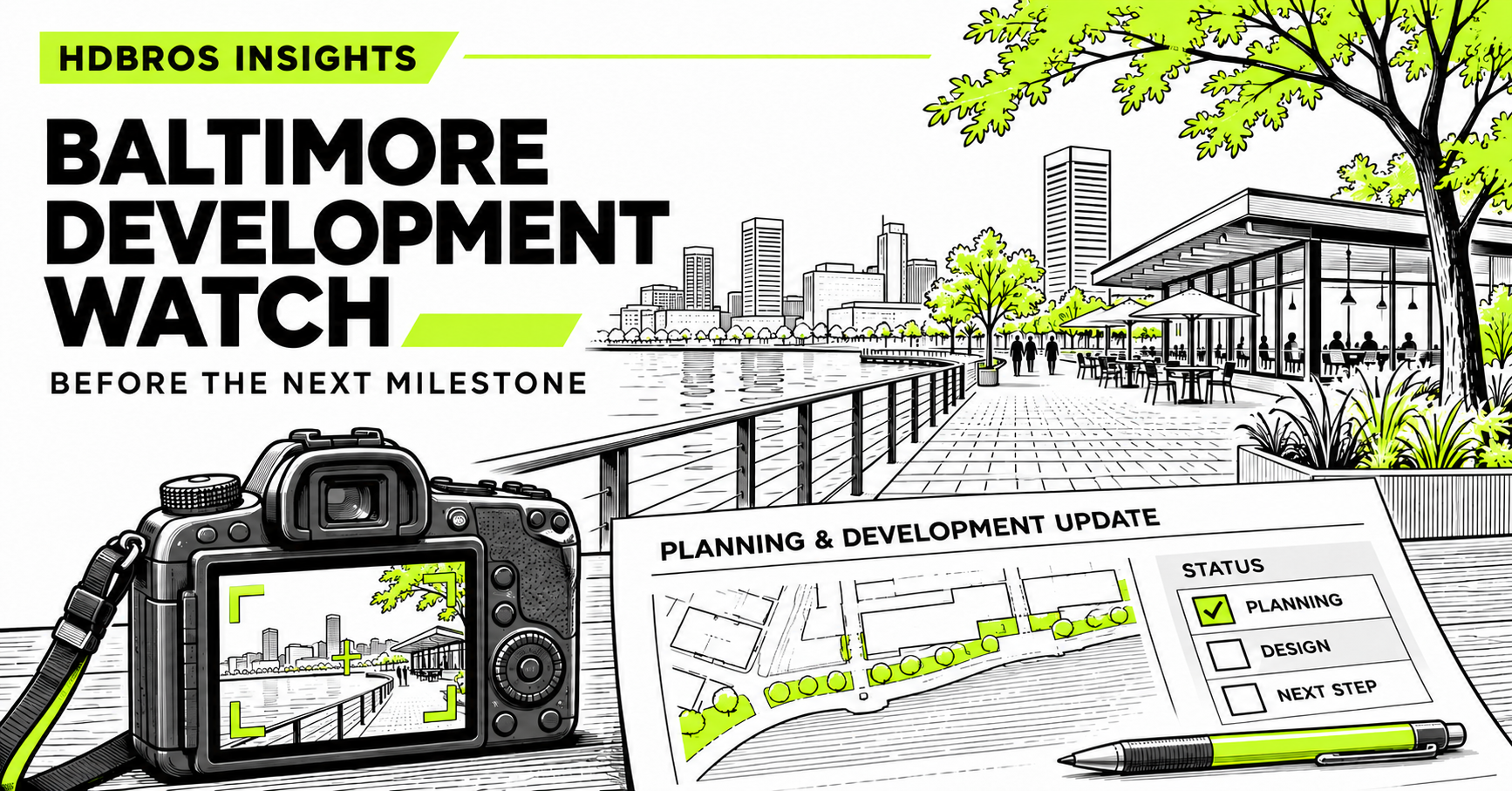

Baltimore Development Watch: Harborplace Terms Announced—What Project Media Should Show Before Approval

HDBROS
A November 23, 2026 update for Baltimore developers, construction communications teams, and commercial property marketers.
Before a redevelopment agreement is approved, your project media should document existing conditions, explain the current stage, and prepare for the next verified milestone. Keep current photographs, proposed designs, and future construction coverage clearly separated. That gives your team useful material today without suggesting that a decision or physical change has already happened.
What changed at Harborplace this week?
On November 19, Baltimore City announced that the City, Baltimore Development Corporation, and MCB Real Estate had reached terms for key Harborplace redevelopment agreements. The City’s announcement schedules a Board of Estimates vote for December 2, 2026, at 9 a.m. As of this November 23 update, that vote is still ahead.
The release also describes a requirement for the developer to demonstrate financing sufficient to complete each phase before construction can begin. An announcement about negotiated terms is therefore different from an approval, a financed phase, or a construction start. Read the City’s November 19 announcement for the primary-source status.
Our earlier Baltimore development watch addressed preconstruction media planning. This week’s new information is the agreement announcement and scheduled vote. The practical recommendations below are HDBROS media-planning guidance, not a claim that HDBROS is working on Harborplace or that construction has started.
Start with a visual status sheet
For any Baltimore redevelopment, create one short document that travels with your image library. Record the project name, jurisdiction, status as of a specific date, source of that status, approved spokesperson, and next decision to check. Assign someone on the project team to approve public captions.
Then classify each asset before it leaves the folder:
- Existing-condition photography: what the camera recorded on a stated date.
- Conceptual or proposed imagery: a design or illustration, labeled with its source and version.
- Construction documentation: observable work captured during an authorized site visit.
- Completed-project imagery: finished spaces photographed when access and readiness are confirmed.
A rendering can explain a proposal, but it should not carry a caption that implies a finished building. A photograph of fencing does not establish that a particular construction phase has begun. Use the project team’s verified information alongside what the image actually shows.
Which existing-condition photographs are useful now?
Build a baseline that answers future questions about how the place changed. Begin with wide views that establish the property within its surroundings, then move to entrances, circulation routes, edges, and representative details. For a waterfront setting, include the relationship between buildings, pedestrian space, and the water where viewpoints are lawful and accessible.
Choose a small number of repeatable ground-level positions. For each, note the direction of view, camera height, approximate framing, and date. A future photographer should be able to understand the intended comparison without guessing. Public access today does not guarantee access next month, so confirm viewpoints again before each visit.
Do not enter restricted land or work areas to reproduce an angle. If aerial context would help, ask the media team to assess airspace, permissions, weather, and operating feasibility before promising drone deliverables. A useful ground-based sequence is better than an unconfirmed aerial commitment.
Plan the next milestone without inventing its date
Separate the work you can commission now from coverage that depends on a decision. Existing-condition photography and an asset audit can proceed when access is authorized. A ceremony, mobilization visit, or first construction-progress shoot needs a confirmed trigger.
Put the trigger in the brief: “schedule after the project representative confirms the milestone and site access,” rather than assuming that a meeting date automatically creates a shoot date. Clarify the notice period, weather alternative, site contact, required safety orientation, and arrangements if the milestone moves.
For ongoing work, our guide to scheduling construction progress photography explains how milestone visits and recurring coverage can work together. Choose the cadence around actual communication needs and visible changes.
Use one organized library across project communications
A stakeholder presentation, a project webpage, and a short social update may all use the same shoot, but they need different selections. Ask for a complete edited library plus a smaller set of approved images for routine updates. Identify horizontal and vertical needs before the photographer composes the shots.
For each selected file, keep a plain-language caption, capture date, photographer credit requirements, and usage information. Add descriptive alt text that explains the image rather than repeating a list of search terms. Archive superseded versions so a colleague does not accidentally publish an old rendering or outdated access view.
When a verified status changes, update the text accompanying the images as well as the images themselves. A current photograph paired with an outdated “under review” or “now open” caption can still confuse your audience.
A practical brief for your next Baltimore media assignment
- Audience: who needs the update, and what should they understand?
- Current stage: what is verified, by whom, and on what date?
- Coverage: baseline views, repeat positions, details, interviews, or milestone footage.
- Access: approved locations, escort, safety requirements, and a backup plan.
- Delivery: intended channels, image orientations, video versions, and caption ownership.
- Next check: the decision or physical milestone that will justify another update.
HDBROS provides Baltimore commercial photography, video, and development media. A clear brief helps us plan coverage around the spaces and decisions your audience needs to understand. Start with the current stage and intended use; build the production scope from there.
Plan Your Project with John
Discuss your property, development stage, access, and the photography or video your team needs next.
If the calendar does not load, open John’s scheduling calendar.