How to Plan a Company Brand Video: Interviews, B-Roll, and Deliverables

HDBROS
To plan a company brand video, decide who should watch it, what they need to understand, and what they should do next. Then connect that message to the interview subjects, real activities, locations, and finished versions you need. A clear brief gives your production team something more useful than “make us look professional.”
This guide is for business owners and marketing teams commissioning a company film, founder story, recruiting video, or introduction to a service. It explains how to prepare people, plan supporting footage, and request deliverables that fit your website, presentations, and social channels.
Start with one audience and one useful message
A prospective customer may want to understand your process. A job candidate may want to hear how a team works. A partner may need to meet the people responsible for a project. Those are different films, even when they are shot in the same building.
Write a one-sentence purpose: “We want prospective clients to understand how our team takes a project from the first conversation through delivery.” This is an example brief, not a promise about results. List the questions that viewer would reasonably have, and decide which the film can actually answer.
Choose the main destination early. An introduction on an About page has a different job than a short recruiting post. Identify the page or campaign where the film will live and a relevant next step, such as exploring a service, viewing work, or contacting your team.
Choose interview subjects for the story they can explain
Use people who know the work and can describe it specifically. A founder can explain why the company exists; a team member can explain a process; a customer or partner may add a different perspective when participation is authorized. Do not add speakers simply to put everyone on screen.
Give each participant the purpose, audience, broad topics, and practical schedule. Encourage concrete examples rather than memorized promotional paragraphs. If wording must be exact, flag it before filming and discuss the best recording approach with the producer.
- What problem do customers bring to your team?
- What happens after someone first contacts the company?
- What does your team do that a visitor would not otherwise see?
- Can you describe a real, approved example of that process?
- What should someone understand before taking the next step?
Share names, titles, and pronunciation in advance. Set aside time for microphone placement, lighting, a few practice answers, and pauses. Ask participants to leave phones silent and avoid accessories that rub against a microphone. Let the crew advise on wardrobe patterns and the interview setting.
Plan B-roll that supports what people say
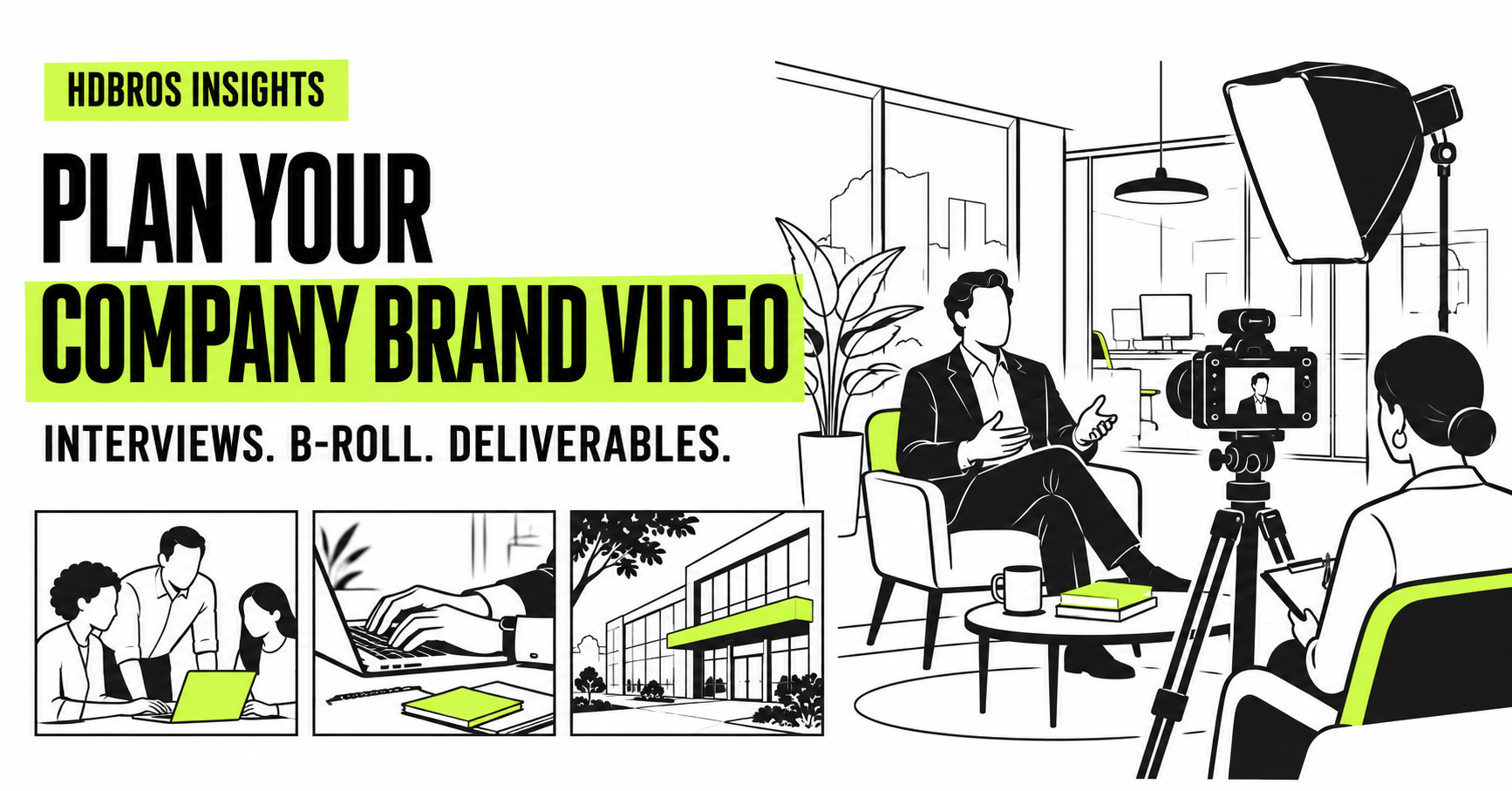
B-roll is the supporting footage shown alongside an interview or narration. Its job is to make the story concrete. If a speaker describes a collaborative review, plan an approved review session. If the film explains a service, show the relevant steps and the people carrying them out.
Build a simple message-to-scene list before the shoot:
- “We listen first”: an approved consultation or team conversation, with confidential details kept out of view.
- “Here is how the work happens”: a short sequence with a beginning, an action, and a visible result.
- “Meet the team”: people doing their normal work, not only a line of posed portraits.
- “This is our setting”: the workplace exterior, arrival, and relevant interior spaces.
These are illustrative scene ideas, not claims about any particular company. Tell the crew which activities will actually happen and which need coordination. Identify the people, work areas, products, screens, or customer material that may appear. Obtain the permissions your organization needs before scheduling those scenes.
Allow time for the crew to capture wider context and closer details of the same action. A few complete sequences often give the editor more useful choices than many unrelated shots. Explain any operation that cannot be interrupted or repeated.
Choose the interview room for sound as well as appearance
A visually impressive lobby can be difficult for an interview if it has constant foot traffic, music, machinery, or a loud ventilation system. Share location photographs and describe likely noise before shoot day. Ask the crew to assess the space rather than assuming background noise can always be fixed in editing.
Confirm access, parking, loading, power, room availability, and the person who can resolve issues on site. Keep the interview space available for the agreed window. Plan supporting footage around business operations so the production does not depend on a room or team member who becomes unavailable halfway through.
Define the finished versions before filming
Discuss duration in relation to the message and placement. There is no single ideal length for every company film. A founder story may need more explanation than a campaign introduction; a short edit still needs a clear idea.
- Main film: intended destination, approximate length, orientation, and primary message.
- Short edits: the number of separate pieces, their topics, openings, and intended channels.
- Framing: horizontal, vertical, or both; important faces and actions may need different compositions.
- Accessibility assets: agreed captions, subtitle files, or transcript requirements.
- Branding: approved logo files, name titles, colors, closing message, and call to action.
- Review: one feedback owner, agreed revision process, and the final approval deadline.
A main film does not automatically include every social version, raw footage, or future edit. Confirm deliverables, music and intended usage, file formats, and any ongoing storage arrangements in the project scope. Give the producer your actual first publishing deadline before booking.
See how different HDBROS films serve different purposes
The HDBROS business brand-film portfolio includes a Brown Distributing commercial, the We Feed Raw founder story, a Turf Valley Resort membership film, and a DRB Homes internship film. Those examples show different storytelling purposes; they do not establish a standard package or guarantee the same results for another company.
Watch with a planning question in mind: who is speaking, what supporting footage helps explain the message, and where would that type of film fit in your own marketing? Bring the examples you prefer and explain why. That is more actionable than asking for a video to feel “cinematic” without describing its job.
Your company brand-video brief
Send the audience, one-sentence purpose, main destination, desired next step, interview candidates, locations, available activities, and first publishing date. Add your requested main film and short edits, the approval owner, and any restrictions on what can be shown. Your media team can then discuss scope, production needs, and a realistic schedule.
If you are also planning a gathering, our company holiday-party media guide covers event coverage and reuse. Event highlights and a planned brand film can support each other, but the interviews and scenes needed to explain a business deserve their own brief.
Plan Your Project with John
Tell John Schwartz who your company wants to reach, what the film needs to explain, and where you plan to use it.
Prefer a direct link? Open John's scheduling calendar →